
Checking Criminal History in St. Clair
The City of St. Clair has no single criminal-history portal. Its Police Department holds city reports, the St. Clair County jail holds bookings, the 72nd District Court and 31st Circuit Court hold case records, and MSP CJIC maintains the statewide repository. Search the layer that answers the question, then compare later records when the outcome matters.
Use this five-step route for a city event:
- Confirm that the City of St. Clair Police Department handled the call or arrest, rather than the county sheriff or another agency.
- Request the incident, arrest, dispatch, photograph, or identified police media through the city's official records channel.
- Search the Marine City branch of MiCOURT D72 by name or case number.
- Check county booking for current custody and C31 when a felony is bound over.
- Use ICHAT for the public MSP repository subset, not as a replacement for the city report or court judgment.
St. Clair City and County Records
Search forms can make “St. Clair” ambiguous. The City of St. Clair is one municipality within St. Clair County. A county filter can return records tied to Port Huron, Marysville, Marine City, Algonac, and other places as well as the city. A city police request is narrower. It reaches records created by the City of St. Clair Police Department, not sheriff incidents from elsewhere in the county.
Use a full city address, the incident location, and the agency name when a portal allows it. In court search, confirm the court branch and case number. In a booking result, read the agency field rather than assuming the city handled the arrest. This distinction is most useful with common names and with events near the river, where several law-enforcement agencies may work in the same broad area.
St. Clair Police Department Records
The City of St. Clair Police Department creates city incident and arrest reports and provides the official route for local police records. A useful request names the Police Department, states the incident number when known, narrows the date and location, identifies the record type, and gives requester contact and delivery details. The city has no separate criminal case database, so filed charges must be searched through MiCOURT.
Ask for specific existing records. A police narrative, 911 audio, dispatch log, photograph, and body-camera recording are different items. Media may need legal review and redaction. Active-investigation details, juvenile data, victim identities, medical facts, LEIN returns, and protected personal identifiers can be withheld. The research did not confirm the current police records desk hours, exact fee schedule, or every live form field, so verify those points on the official city page before submitting or visiting.
St. Clair Criminal Records History
The city once stood at the center of county justice. The first St. Clair County jail was built in the City of St. Clair in 1827. County-seat and jail functions shifted to Port Huron in 1871, and today's county correctional complex sits on Michigan Road. The history explains why a modern city arrest can begin in St. Clair but leave its booking and major court trail in other county locations.
The official City of St. Clair source supplied the city image assigned to this record page.
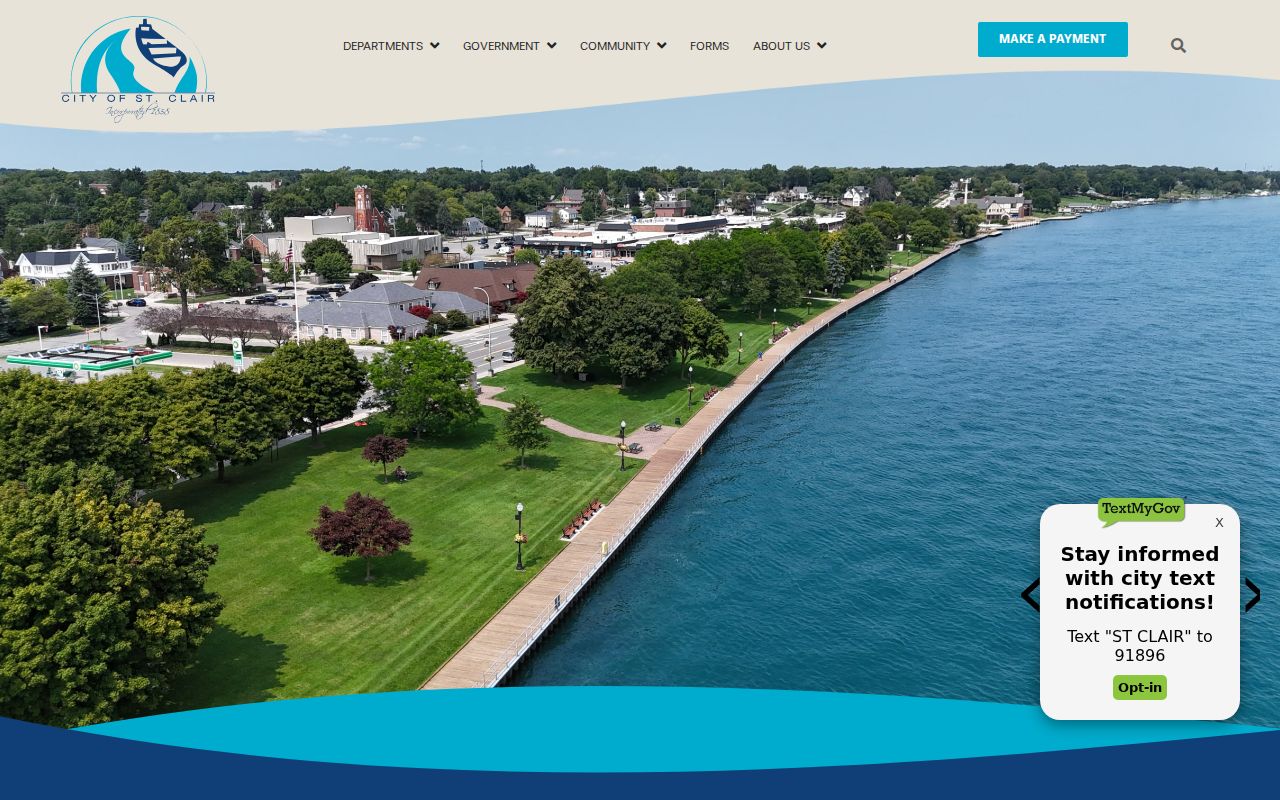
The view reinforces the city-level starting point, while the old jail story helps explain why present-day record custodians are split between the city, Marine City court branch, and Port Huron county offices.
That move does not erase the city police layer. The St. Clair Police Department still owns its reports. It means only that a lodged person and a filed criminal case enter county institutions after the local event. Historical research should use dated county sources, while a current case should follow today's agency and court route.
St. Clair Arrests and Bookings
A person lodged after a City of St. Clair arrest is booked through the St. Clair County jail at 1170 Michigan Road in Port Huron. The official current-booking search accepts a last name, first name, or booking number. A public profile may show booking date, age, gender, booking number, charge groups, bond, court, and arresting agency. The data refreshes during the day and is limited to current custody.
Release or transfer may remove a person from the roster. An older booking requires a focused sheriff records request with the approximate date and identifiers. The city police report must still come from St. Clair Police. For MDOC prison, parole, or felony probation status, use OTIS. No booking charge or photograph proves guilt. Court dispositions can dismiss, change, or resolve the allegation in a way that the first intake label does not show.
Requesting St. Clair Police Records
A narrow request moves faster than a broad demand for “all records.” State the City of St. Clair Police Department, incident number if known, date and time range, location, record type, requester contact, and desired delivery format. If the goal is a particular media file, name it. Existing body-camera footage, a 911 recording, and a dispatch log should not be assumed to come with a paper report.
Michigan FOIA applies to the city police channel. A written request generally triggers a response within five business days, and the city may issue a written extension of up to ten more business days. A response can grant, deny, partly grant, seek more detail, or require a deposit under the local process. Production may take longer for extensive video. A denial should identify the exemption and state the appeal route. The law does not force the city to create a new combined criminal-history summary.
Municipal Court Records in St. Clair
The City of St. Clair has no separate municipal criminal court. City ordinance and civil-infraction matters, misdemeanors, and felony preliminary stages route through the Marine City branch of the 72nd District Court. A felony that is bound over then continues in the 31st Judicial Circuit Court. MiCOURT provides a first look, while the clerk's file is the official record.
| Court Name | 72nd District Court, Marine City branch; 31st Judicial Circuit Court after felony bind-over |
|---|---|
| Case Types Heard | St. Clair ordinance and civil-infraction matters, misdemeanors, and early felony proceedings |
| Case Lookup Channel | MiCOURT D72, then MiCOURT C31 for a bound-over felony; clerk contact for official documents |
| What the Docket Shows | Public case number, status, judge, charge, plea, disposition, sentence, hearings, and register-of-actions events |
| Copies & Fees | Public inspection and retrieval are free under MCR 8.119; copies and certification may cost extra |
The Marine City court is at 2088 South Parker, Marine City, MI 48039, with a published phone of 810-765-4057. Search by a complete legal name or case number. MiCOURT is informational and may not display every old case or document, so contact the clerk when a known St. Clair record is missing.
Narrowing St. Clair Criminal Record Searches
When a county search returns too many results, start with the record creator. Use City of St. Clair Police for the report, the Marine City D72 context for the first court stage, and the arresting-agency field in the county booking tool. Add exact legal spelling and date of birth in MiCOURT when available. A complete case number is stronger than a name alone.
If MiCOURT returns nothing, check both D72 and C31, inspect the case-number format, and consider the court's possible seven-year display filter. A new arrest may not yet be indexed. An old file may require direct clerk contact. If ICHAT returns no public record, remember that it omits warrants, juvenile, traffic, federal, tribal, local-misdemeanor, out-of-state, and suppressed material. Narrowing the search means choosing a better source, not assuming an empty result answers every question.
Note: A city name filter and a county name filter answer different geographic questions even when both display “St. Clair.”
Where St. Clair Records Go
The City of St. Clair Police Department creates the first agency record. If the person is lodged, the county jail adds a booking. A prosecutor-approved complaint appears in D72, where a misdemeanor may end or a felony may be bound over. C31 then handles the felony information, plea or trial, sentence, and later proceedings. Reportable arrest and disposition data flows to Michigan State Police CJIC.
Record flow: City of St. Clair Police Department › St. Clair County Jail › 72nd District Court, Marine City › 31st Judicial Circuit Court when bound over › Michigan State Police CJIC
Each step can update at a different time. Search city police and booking sources for a very recent event, court records for filed charges and outcomes, and ICHAT for the public repository subset. The broader county criminal records overview explains other state and custody channels without replacing the city-first search.
St. Clair River Arrest Records
St. Clair sits on the river in a county with about 115 square miles of water. The county Sheriff's Marine Division patrols Lake Huron, Lake St. Clair, rivers, canals, and the Flats. City police, sheriff deputies, Michigan DNR officers, the Coast Guard, MSP, and federal officers can therefore create separate records around one broad waterway area.
Find the arresting agency before filing. A City of St. Clair Police incident belongs with the city. A sheriff marine arrest belongs with the Sheriff's Service Bureau. A DNR or federal event follows that agency's records process, and a filed federal case uses PACER rather than MiCOURT. Geographic closeness is not enough to choose the custodian. The agency named on the citation, booking entry, or complaint is the best routing clue.
Public Access Rules in St. Clair
City police files and court records follow separate public-access rules. Michigan FOIA governs requests for existing City of St. Clair Police records, subject to lawful exemptions and redactions. Courts are excluded from FOIA and use Michigan Court Rule 8.119. Juvenile, set-aside, victim, medical, LEIN, and protected identifying data can remain nonpublic even when other parts of a record are released.
Key Statutes:
Michigan Freedom of Information Act, MCL 15.231 et seq. provides the public process for requesting existing city police records.
MCL 15.232(h)(iv) excludes the Michigan judiciary from FOIA.
Michigan Court Rule 8.119 governs access to unrestricted D72 and C31 case records.
MCL 28.242 directs reportable arrest and identification data into the MSP repository.
Reading St. Clair Crime Records
Use the FBI Crime Data Explorer with the City of St. Clair Police Department selected and one complete year. Keep reported offenses, arrests, and clearances separate. These measures are not interchangeable. Arrests describe enforcement events, not convictions. Clearances can include an arrest or an exceptional clearance. Reported offenses do not count every event experienced by residents.
Do not mix the city police count with the county sheriff total. Agency coverage can overlap along roads and the river, and a county total can include many municipalities. Record the agency, year, measure, and reporting coverage beside each figure. Avoid treating a partial year as a full year. This method gives St. Clair local context while keeping agency data separate from any individual's police or court record.
When the city agency has no complete submission for a chosen period, pick another complete year or state the coverage gap. Do not fill missing city values with county figures. A sound note should preserve the table's own label and distinguish arrests from charges filed in D72. The court count reflects prosecution activity, while the police count reflects agency reporting. Both can help explain St. Clair records, but neither should be read as a finding about a person. Keep the date range visible with the result.